
Built for Trust
Building Organizations That Deserve Trust
A practical framework for CEOs, CMOs and boards who want to turn credibility from a communications aspiration into an operating capability—and a durable source of competitive advantage.

Credibility Compounds.
Customers, employees, investors and boards now evaluate organizational claims in real time. In that environment, trust cannot be left to messaging or good intentions. It is earned when promises, evidence, decisions and behavior reinforce one another.
Five Fractures. One Connected System.
Trust rarely fails because of one spectacular mistake. It weakens across smaller gaps between what an organization says, what the evidence supports and what stakeholders experience.
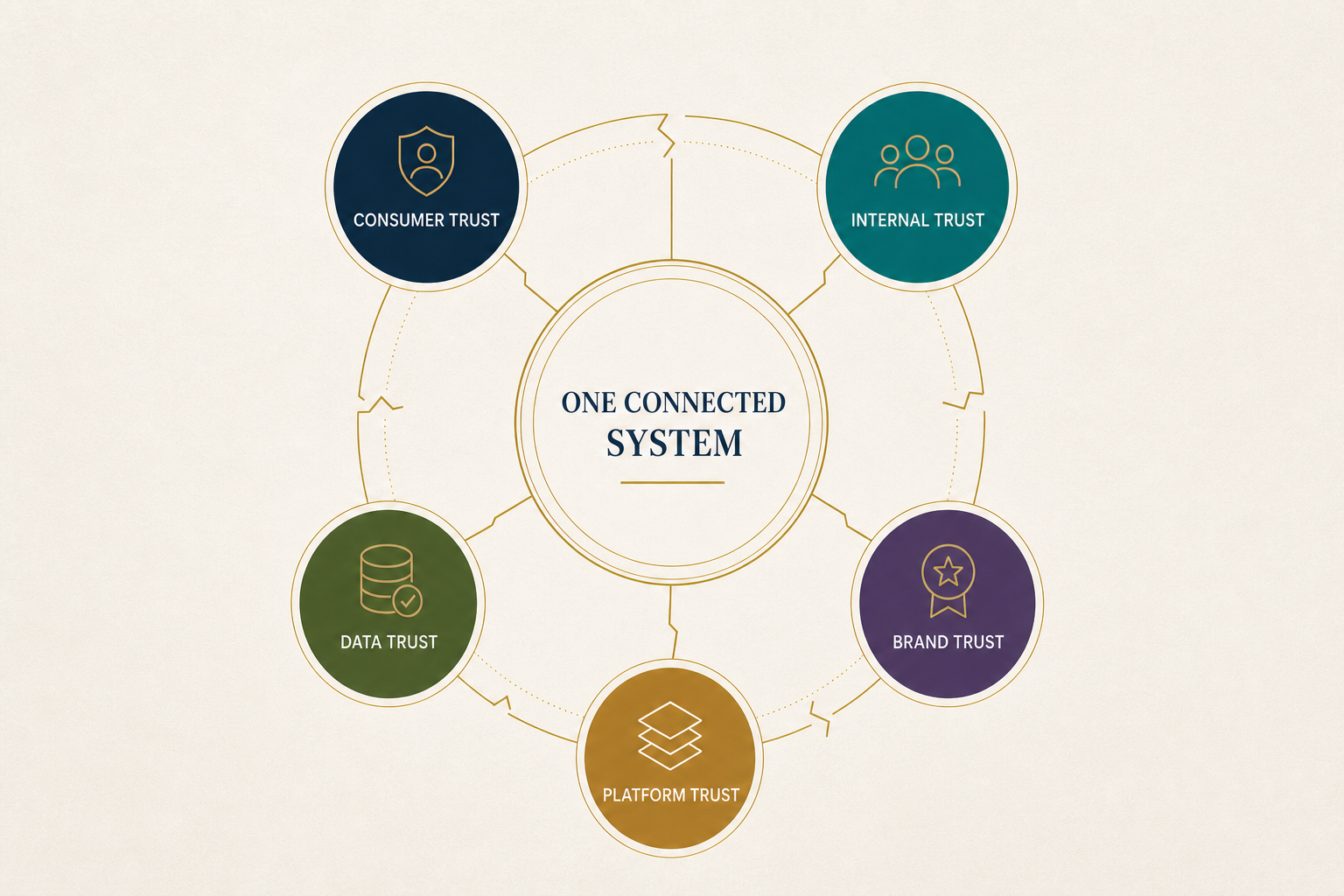
Move Beyond Trust Theater.
Trust Theater performs credibility. Trust Architecture builds the operating discipline behind it—connecting claims with evidence, leadership with accountability, technology with governance and brand promises with business performance.
Diagnose
Find the fractures
Govern
Assign accountability
Build
Design proof and coherence
Measure
Track value and cost
A Practical Operating System for Credibility.
Research, consequential business cases, practical tools and a business parable help leaders move from recognizing the problem to building the capability required to address it.
Recognize
Find the Five Fractures before they become connected business failures.
Distinguish
Separate communications problems from operating-system problems.
Govern
Clarify accountability among the board, CEO, CMO and operating leaders.
Build
Design proof into customer, employee and investor claims.
Navigate AI
Govern data, platforms and AI without paralyzing innovation.
Measure
Identify where credibility creates value—or distrust creates cost.
Not a book about appearing trustworthy. A book about becoming worthy of trust.
When the Fractures Begin to Connect.
At first, the problems appear manageable: a questionable customer claim, unreliable data, an AI-related credibility issue, a platform dependency nobody fully owns and a growing gap between what leadership says and what employees experience.
Nothing looks fatal. That is how trust usually breaks.
The parable is the book's proving ground. As Adrienne works alongside Solara's leadership team, each framework is tested against decisions with real operating, human and financial consequences. Readers see apparently isolated trust failures begin to reinforce one another—and why repairing the story alone cannot restore credibility.
Solara is a fictional, fast-growing technology-enabled company with an ambitious promise, complex data and platform dependencies, and a widening gap between what leaders believe and what customers and employees experience. Its situation makes the Five Fractures concrete without tying the lessons to a single industry.
Adrienne's challenge is not to repair the message. It is to help Solara rebuild the system behind it.

How Mature Is Your Approach to Trust?
The Trust Maturity Diagnostic assesses credibility across leadership, customers, operations, technology, information and culture—then identifies where trust is compounding and where hidden friction may be creating cost.
Trust Architecture

What Would Your Organization Need to Prove?
The question is not whether trust matters. It is whether your organization has built the systems required to deserve it.