On Building Internal Trust in the AI Era

Last week HubSpot announced it is eliminating about 660 positions, roughly 7% of its global workforce, in a restructuring tied to its shift toward AI-driven customer outcomes. According to the Boston Globe, severance includes a minimum of 20 weeks of base pay, laptop retention, and support with the next job search. CEO Yamini Rangan told employees the aim is a flatter organization, with decisions closer to the people doing the work.
Then came a moment every leader should study with empathy, not judgment. Co-founder and CTO Dharmesh Shah posted on LinkedIn: "My personal thanks to all of the people that HubSpot parted ways with today. You helped make HubSpot the company it is. Best wishes with the next chapter." Many readers felt it was too brief; others praised him for acknowledging people during a difficult transition. Shah then updated the post: "My original post was curt and insensitive. I'm sincerely sorry." He had meant to express gratitude, he wrote, but "failed to acknowledge the pain and uncertainty of being laid off."
I respect that apology. It was specific, owned, and said what he should have done differently. Few leaders manage all three.
The test comes before the spreadsheet
Restructurings usually get told as cost stories. HubSpot's has that element: $65 million to $75 million in expected charges, mostly severance and transition payments. But Rangan framed the change as a shift in how the company operates, not a response to cost pressure. That is exactly why it is a trust story first. When leaders say "this is about how we work," employees judge it by how the change is carried out.
In Built for Trust, I describe internal trust as the infrastructure beneath external credibility. AI raises the stakes, because people fill silence with their own assumptions about what it means for them. And the gap between what leaders say and what employees experience no longer stays inside the building. It shows up in public comment threads that customers, candidates, and investors can read.
Shah's post was not a strategy failure. It was a coherence gap: real gratitude in a register that did not match what hundreds of people were living that day.
A short playbook for CEOs
The book's starting point is what I call the AI Trust Compact, which opens with a simple commitment: "AI will change the work, and we will be honest about how." Six operating practices make it credible:
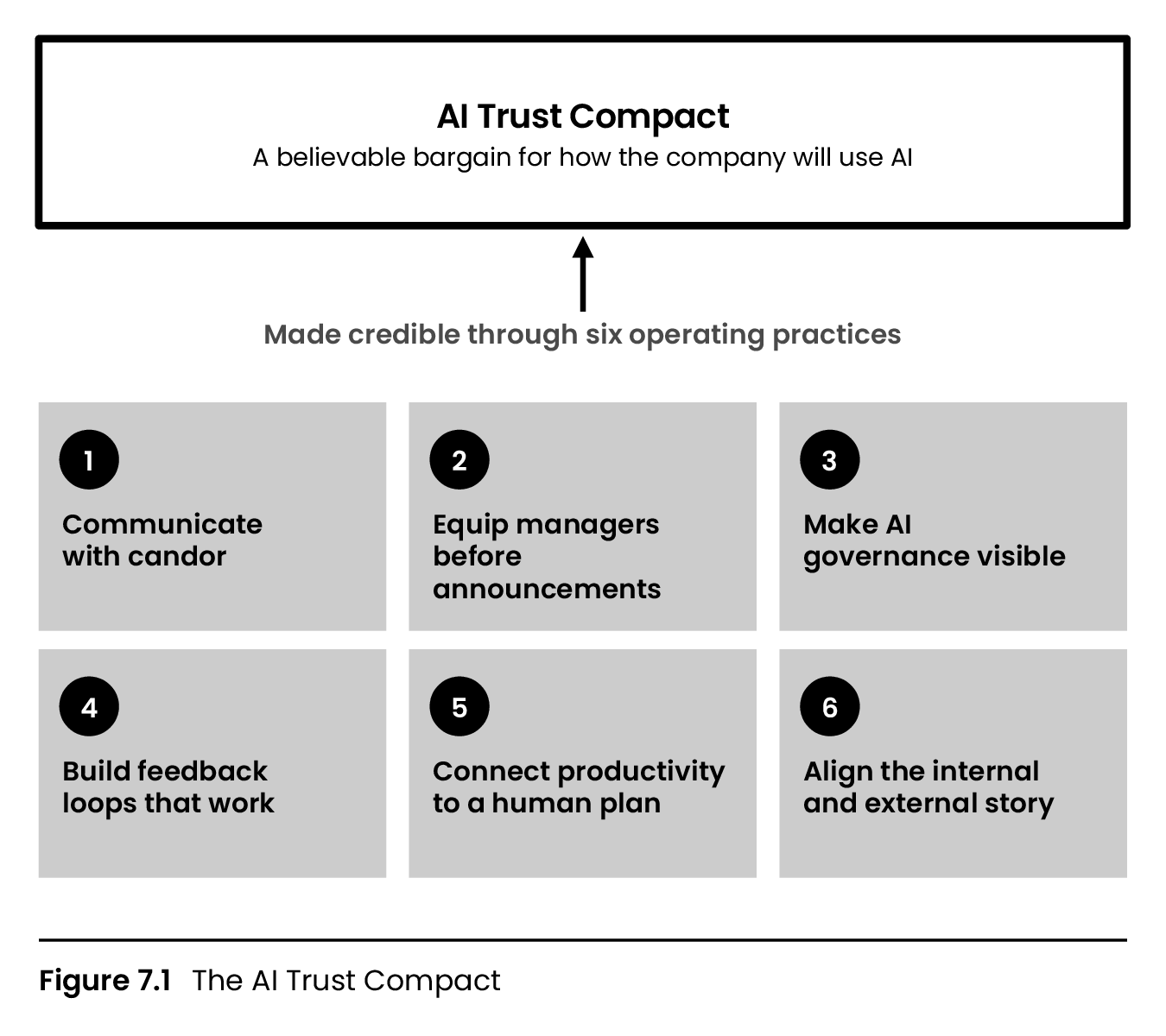
Communicate with candor. State what AI will change, what it will not, and what you do not know yet. Share only what you know for certain.
Equip managers before announcements. Give them context, language, and time for their own questions. A manager who can say, "I do not know yet, but I know what we are asking," is more credible than one reading a laminated FAQ.
Make AI governance visible. Show who decides where AI is used, how those decisions are reviewed, and where humans remain accountable.
Build feedback loops that work. Give employees a real channel to raise concerns, and show them what changed because they did.
Connect productivity to a human plan. Explain where AI's gains go: training, job redesign, new roles. Write for the people leaving first, and test each line: would someone who lost their job today recognize their experience in it?
Align the internal and external story. Employees should recognize the company described to customers and investors as the organization they experience every day. Otherwise a people-first message becomes trust theater: language stronger than the operating system.
Holding these together is the CEO's job as Chief Coherence Officer. This is not a new box on the org chart; it is how the CEO must lead. Words, incentives, decisions, and behavior should point in the same direction, across every executive voice. When a gap shows, repair it in the open: name it, own it, fix it. Trust cannot be delegated.
Do this next
Before your next AI-driven change, ask your leadership team: if an affected employee read every message we plan to send, internal and public, would they believe all of them at once?
Not sure? Start by finding out where you stand. The Trust Maturity Diagnostic™ shows where your organization sits on the Trust Maturity Model™, and Trust Architecture™ is the method for moving up it.
For the full playbook, Built for Trust (Greenleaf, 2027) is available to pre-order.