
On The Fragmentation of Trust
Announcing a New Book to Help Leaders Rebuild Credibility When Reality, Technology, and Institutions No Longer Agree

Trust used to be earned slowly.
A company said what it believed.
Customers watched what it did.
Employees decided whether the story matched the experience.
Investors looked for consistency.
Over time, trust either accumulated or it didn’t.
That world has not disappeared.
It has just become a lot noisier.
Today, trust can fracture in an afternoon.
A fake video can look real. A real data point can look suspicious. A media platform can change the rules without much explanation. An AI claim can sound impressive right up until someone asks, “Can we actually prove that?” Employees can nod along in the all-hands meeting while quietly wondering whether the strategy deck was written for them, the board, or the LinkedIn algorithm.
Welcome to the modern trust problem.
This is why I am writing The Fragmentation of Trust.
The book starts with a simple idea: trust is no longer just a brand asset, a communications goal, or a line item in the values statement. Trust has become a business system. And like any system, it can be designed well, neglected badly, or duct-taped together at great expense while everyone pretends the duct tape is a strategy.
For many companies, the old response to a trust problem was communications.
Say more. Explain better. Issue a statement. Refresh the brand language. Schedule a town hall. Add the word “transparent” to the first paragraph and hope no one asks follow-up questions.
That is what I call “Trust Theater".
Trust theater is what happens when companies try to perform credibility instead of building it. It may calm the room for a moment, but it does not solve the underlying problem. In fact, it often makes the problem worse because people can feel the difference between a company trying to be trusted and a company willing to become trustworthy.
The alternative is what I call “Trust Architecture".
Trust Architecture is the operating system behind credibility. It is the way a company designs proof into its claims, coherence into its culture, transparency into its data, boundaries into its AI, and consistency into its decisions. It asks leaders to stop treating trust as a speech and start treating it as a discipline.
The book explores five major fractures that are reshaping leadership today:
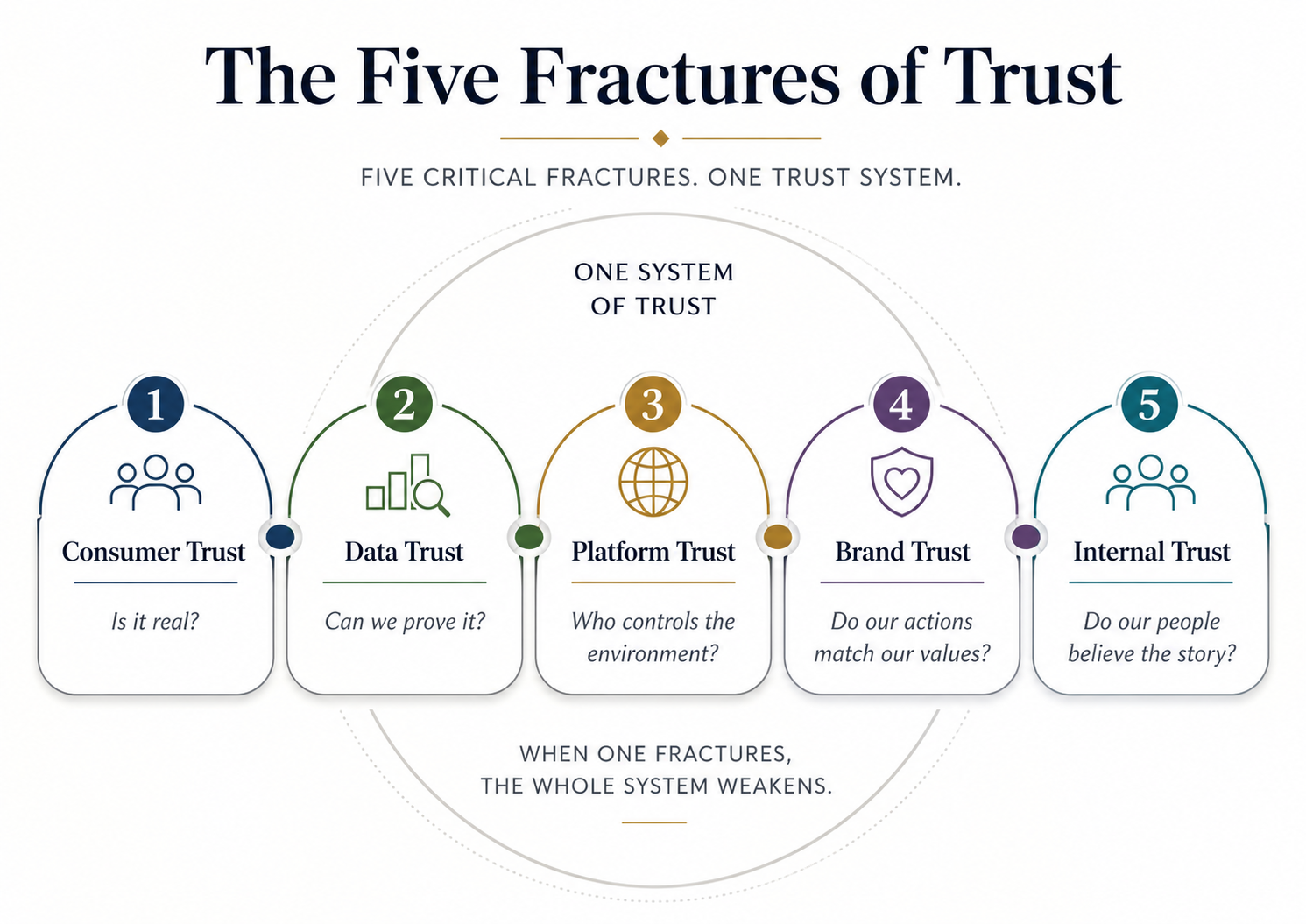
Individually, each fracture is hard enough. Together, they compound.
That is where the book becomes a story.
Fragmentation of Trust is wrapped inside a business parable about an executive team that begins to experience trust failures from every direction. At first, the issues seem manageable. A confusing customer signal here. A data concern there. A platform dependency nobody fully owns. An AI-related credibility problem. A gap between what the company says externally and what employees are experiencing internally.
Nothing looks fatal at first.
That is how trust usually breaks. Not with one giant explosion, but through a series of smaller doubts that start connecting.
The team in the story eventually discovers that doubt has a cost. It slows decisions. It weakens culture. It makes customers hesitate. It makes employees cautious. It turns every claim into a courtroom exhibit. And once that happens, the leadership team has a choice: keep polishing the message, or rebuild the system behind the message.
The book is really about that choice.
I am writing The Fragmentation of Trust for CEOs, CMOs, boards, and senior leaders who sense that something has changed but may not yet have language for it. Many leaders know trust matters. Fewer have a practical model for how to build it in an environment where AI can blur reality, data can be questioned, platforms can obscure accountability, and employees can lose confidence faster than a CFO can say “EBITDA.”
This is not a book about being nicer. Although, for the record, being nicer is rarely a terrible idea.
It is a book about building companies people can actually believe.
The companies that win in the next era will not simply be the ones with the best message. They will be the ones with the strongest proof. They will not just tell a better story. They will build the systems that make the story true.
That is the shift from “Trust Theater” to “Trust Architecture”.
And that is the journey at the center of The Fragmentation of Trust.
More soon. I’ll be sharing pieces of the framework, excerpts from the parable, and practical tools leaders can use to pressure-test their own organizations.
In the meantime, here is the question I would leave you with:
If trust in your company started to fracture tomorrow, would your organization know how to respond — or would it just schedule another meeting to discuss the communications plan?