
November 9, 2026 · Marcus Center for Advanced Rehabilitation at Shepherd Center, Atlanta
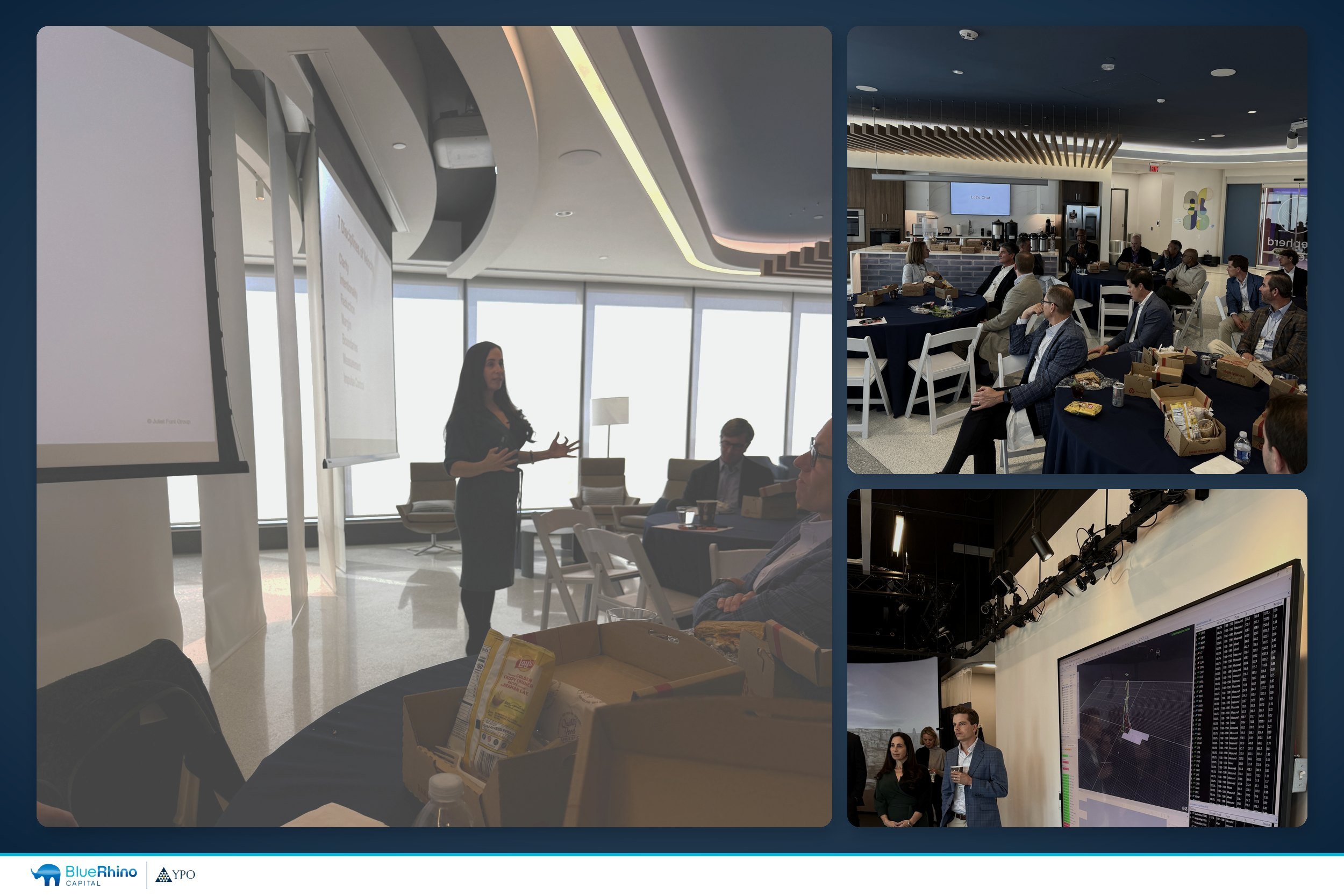
As YPOers, most of us are pretty good at adding priorities to our lives. Deciding what to stop doing is a little harder. Today, members of YPO Southern 7 gathered at the Marcus Center for Advanced Rehabilitation at Shepherd Center in Atlanta to work on exactly that.
Our thanks start with Jamie Shepherd, who gave us a tour of the Marcus Center. Seeing the work done there firsthand was a powerful reminder of what focus and purpose look like when they matter most.
Our speaker, Juliet Funt, helps leaders and their teams make room for the work that matters most. She's the founder and CEO of the Juliet Funt Group and the author of A Minute to Think, and she has worked with leaders across Fortune 500 companies and the US military to cut unnecessary work and create more time for clear thinking and better execution.
One of my favorite lines from her book is this: "Under pressure, we value our own burning needs more than the time we steal from others." It's a good reminder that as leaders, our urgency can quickly become everyone else's urgency.
Start with the Wedge
Juliet's simplest tool is the Wedge. In A Minute to Think, she describes it as "a small portion of white space inserted between two activities. It's used specifically to pry apart actions or events that without it would have been connected." A few seconds between a question and your answer, or between one meeting and the next, buys you a moment to think before you act. For leaders who move fast, that pause is often the difference between reacting and deciding.
The De-Selection Advantage
Most of us confuse prioritizing with subtracting. Reordering the pile isn't the same as shrinking it. As Juliet put it, "we are not infinite, but the work is." The leaders who gain velocity aren't the ones who work harder. They're the ones who simplify, clearing away the low-value work that slows everything else down.
Her tool for that is the Spin Launcher, a five-step process: Generate, Separate, Evaluate, Eliminate and Liberate. Teams list what they'd like to stop doing, separate what they can control from what they can't, test each item against how close it sits to the mission, cut, and then put the freed-up time to work on what matters most. She reminds leaders not to ignore the small cuts. Shortening a meeting or ending a reply-all habit seems minor, but in her words, "if you eat enough krill, you grow a whale."
Protect the deep work
Cutting work only matters if you protect what you free up. Juliet encouraged us to set aside a Deep Work Day: a block of time with no meetings and no inbox, for the strategic thinking that never fits between calls. For most of us, that is where the real leverage is.
What I'm taking back to the office
The question I left with is a simple one: what would I stop doing tomorrow if I were honest about its value? Every commitment we keep out of habit is time we can't give to the commitments that matter.
Thank you, Juliet, for helping us think differently, and thank you to Jamie and the Shepherd Center team for hosting us.
To find out the economic impact of what may be at stake in your organization, check out WastedPayroll.com.
To learn more about The De-Selection Advantage, reach out to Juliet Funt at juliet@jfgcanhelp.com.
Dave Sutton, Managing Partner, Blue Rhino Capital